
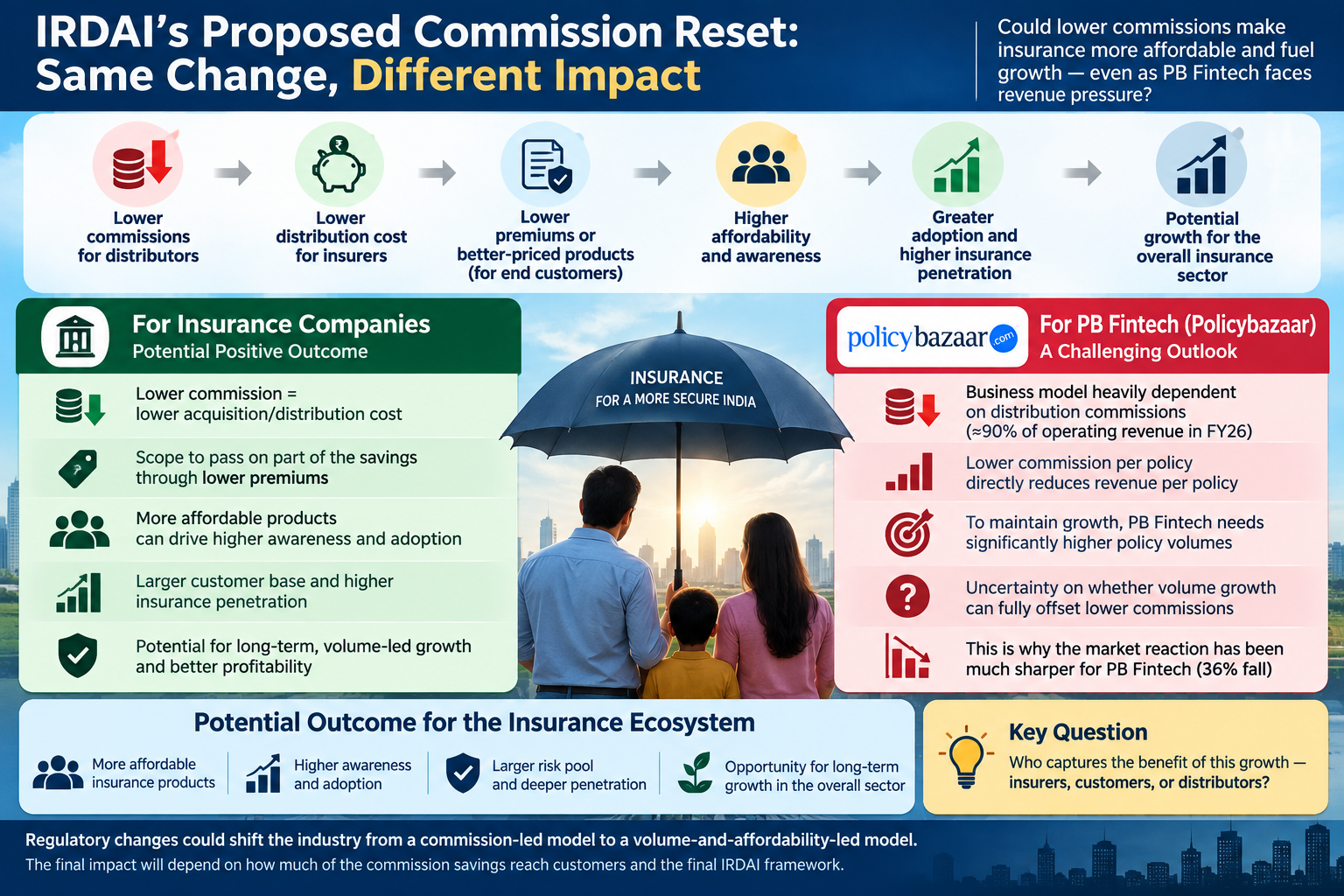
IRDAI’s proposed commission reset creates an interesting paradox for the insurance sector.
If insurers pass a meaningful portion of the commission savings to customers through lower premiums, insurance could become more affordable.
Lower premiums → higher affordability → greater adoption → larger insurance pool → potentially higher insurance penetration.
That could be positive for the insurance industry in the long run.
But for insurance distributors such as PB Fintech, the equation is different.
PB Fintech’s business model is heavily dependent on insurance distribution commissions. In FY26, around 90% of its operating revenue came from insurance commission, according to reported company/industry data.
Therefore:
Lower commission × same volume = lower distributor revenue
To maintain growth, PB Fintech would need:
Lower commission per policy + significantly higher policy volumes = sustainable growth
And this is where the real debate begins.
The proposed framework could potentially shift the insurance industry from a commission-led distribution model toward a volume-and-affordability-led model.
For insurers, that could mean lower acquisition costs and potentially greater volumes.
For distributors, however, the challenge is whether volume growth can compensate for the compression in revenue per policy.
This may explain why the market reaction has been much sharper for PB Fintech than for some insurers. The proposed rules are still under consultation, so the final economics remain uncertain.
The interesting question isn’t simply “Will insurance grow?”
It’s:
“Who captures the benefit of that growth—insurers, customers, or distributors?”
Aakash Bisht


One Reply to “PB Fintech: Buying Opportunity or Structural Value Trap?”
A WordPress CommenterJune 17, 2025
Hi, this is a comment.
To get started with moderating, editing, and deleting comments, please visit the Comments screen in the dashboard.
Commenter avatars come from Gravatar.