
- October 21, 2026
- Capitree Asset LLP
“India’s Stock Market Paradox: If Domestic Money Is Flowing In, Why Are Investors Struggling?”
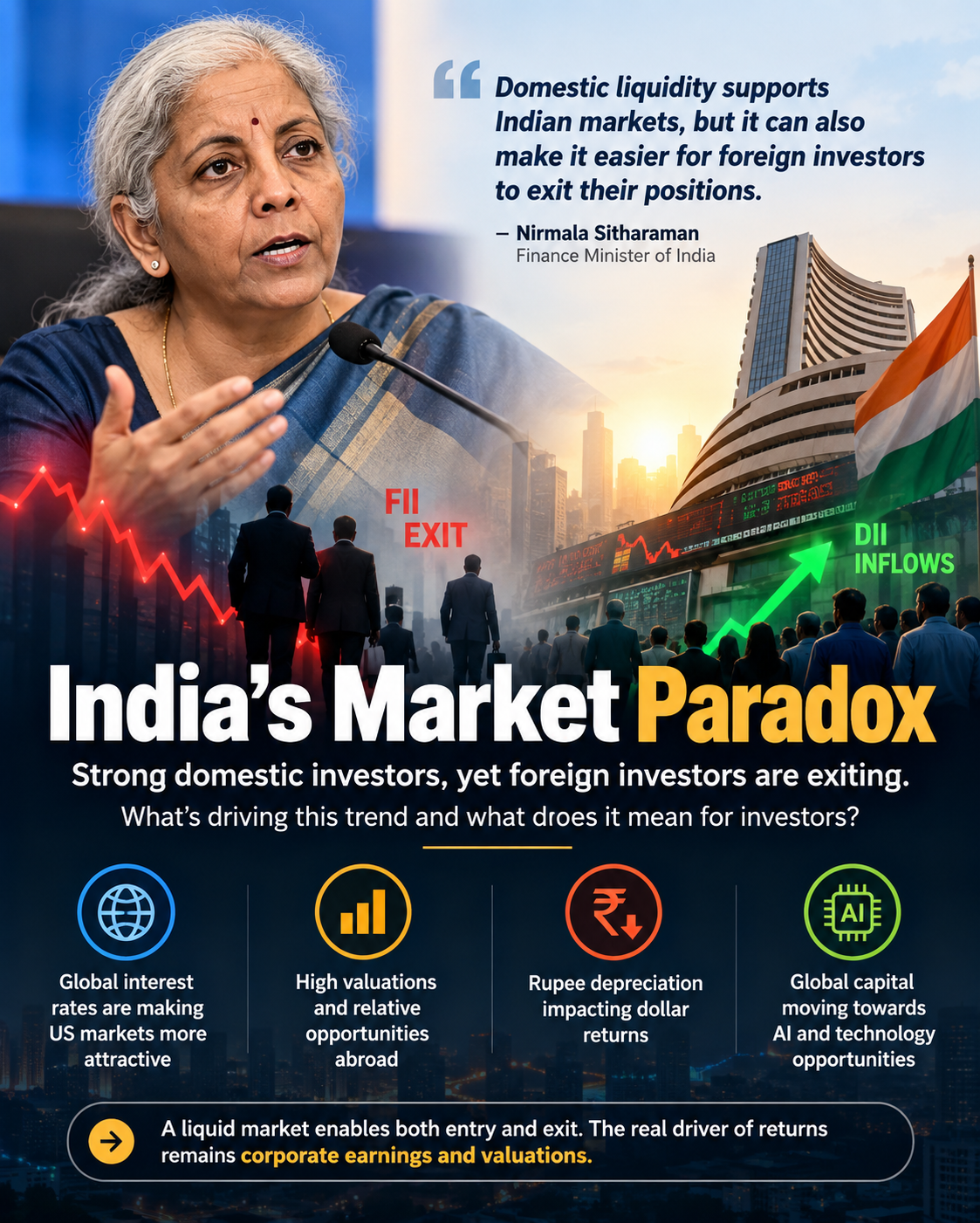
India’s Stock Market Paradox: When Liquidity Supports Exits More Than Growth An investor’s perspective on Finance Minister Nirmala Sitharaman’s recent comments on Indian equities. India’s stock market is facing a question that goes beyond daily market movements: If domestic investors continue investing, why are Indian equities struggling to deliver strong returns? On October 19, 2026, Finance Minister Nirmala Sitharaman highlighted a potential paradox in the Indian equity market. While domestic liquidity continues to support the market, the same liquidity can make it easier for foreign investors and existing shareholders to exit their positions. Her comments came amid sustained foreign portfolio investor (FPI) selling and a period of weakness in benchmark indices. She also identified global capital moving towards the United States and artificial intelligence-linked opportunities as a concern for India. Source: NDTV Profit — The Liquidity Paradox 1. The liquidity paradox: Who is buying, and who is selling? India has developed a deeper domestic investment base, supported by mutual fund contributions and participation from retail investors. However, domestic buying does not automatically translate into rising share prices when substantial selling pressure persists. Consider the market dynamics: Domestic investors: Continue allocating money to equity mutual funds and other market instruments. Foreign investors: Reassess their allocations based on global interest rates, currency movements, relative valuations and investment opportunities elsewhere. Existing shareholders: May use strong domestic demand to sell shares through public markets. New investors: Must evaluate whether the prices they pay are justified by future earnings growth. The result is a market in which liquidity remains available, but the direction of prices depends on the balance between buying demand, selling pressure and valuations. The important distinction is that liquidity makes transactions easier; it does not guarantee attractive returns. 2. Why is foreign capital moving away from India? Foreign investors compare India with other markets rather than evaluating the country in isolation. Several factors influence their decisions: Global interest rates: Higher US Treasury yields can make dollar-denominated investments more attractive relative to emerging-market equities. Currency depreciation: A weakening rupee can reduce foreign investors’ dollar-denominated returns, even when their Indian holdings perform reasonably well in local currency. Valuation concerns: If Indian equities trade at a premium to comparable markets, investors may demand stronger earnings growth to justify that premium. Artificial intelligence and technology opportunities: Global capital has increasingly focused on markets with significant exposure to AI-related companies, including semiconductor and technology businesses. These factors can influence capital allocation even when India’s domestic economic fundamentals remain relatively resilient. The finance minister’s remarks highlight a strategic challenge: India must remain competitive not only in attracting capital but also in generating returns that justify long-term investment. 3. Does domestic liquidity create a false sense of security? Domestic participation is a structural strength for Indian markets. Regular mutual fund inflows can help absorb selling pressure and reduce dependence on foreign investors. However, there is an important distinction between market resilience and market performance. A market can remain liquid and functional while delivering disappointing returns if valuations are elevated, earnings growth slows, or selling pressure persists. Domestic investors should therefore avoid assuming that sustained mutual fund inflows will automatically protect their portfolios from corrections. Similarly, foreign selling should not automatically be interpreted as a rejection of India’s long-term economic prospects. Capital flows are influenced by global portfolio decisions, liquidity requirements and relative opportunities. The real test is whether corporate earnings and cash flows can support the prices investors are paying. 4. What does this mean for investors? For long-term investors, the finance minister’s comments offer three practical lessons. First, separate economic growth from stock market returns. A growing economy creates opportunities, but shareholders earn returns based on the businesses they own, the prices they pay, and the cash flows those businesses generate. Second, pay attention to valuations. Strong narratives around infrastructure, digitalisation, manufacturing and AI do not make every company in those sectors an attractive investment. Valuation discipline remains essential. Third, diversify intelligently. A portfolio concentrated in a handful of expensive stocks or sectors may face significant volatility. Investors should assess diversification across businesses, sectors and asset classes in line with their goals and risk tolerance. For investors using systematic investment plans, market weakness can provide opportunities to accumulate quality businesses at more reasonable valuations. However, an SIP does not eliminate the risk of losses, and investment choices should still be based on fundamentals and financial objectives. 5. What should policymakers and market participants focus on? India’s long-term objective should not simply be to retain foreign capital at any cost. It should be to create an environment in which both domestic and international investors can identify productive opportunities. Three areas deserve attention: Corporate earnings quality: Sustainable profit growth, transparent disclosures and disciplined capital allocation. Market competitiveness: Predictable regulation, reasonable transaction costs and an efficient investment environment. Productive capital formation: Encouraging investment that supports business expansion, innovation, infrastructure and employment. Capital gains taxation and securities transaction tax are also relevant to investor sentiment. However, tax relief alone cannot guarantee sustained market appreciation if earnings, valuations and global conditions remain unfavourable. My view: Liquidity is the mechanism, not the complete explanation The finance minister’s comments identify an important feature of modern equity markets: the same liquidity that enables investors to enter positions also enables them to exit quickly. But liquidity should not be treated as the sole explanation for weak market returns. Foreign outflows, relative valuations, currency movements, global investment trends and corporate earnings all matter. India’s domestic investor base is an advantage, but it cannot indefinitely compensate for weak earnings or excessive valuations. Ultimately, the market needs more than money flowing into financial instruments. It needs capital allocated to productive businesses capable of generating sustainable earnings and cash flows. For investors, the key question is not merely whether money is entering or leaving the market. It is whether the underlying businesses are creating enough value to justify their valuations. That is the distinction between following market liquidity and investing with conviction. Aakash Bisht, Strategic Consultant Disclaimer: This article
- June 17, 2025
- Capitree Asset LLP
PB Fintech: Buying Opportunity or Structural Value Trap?
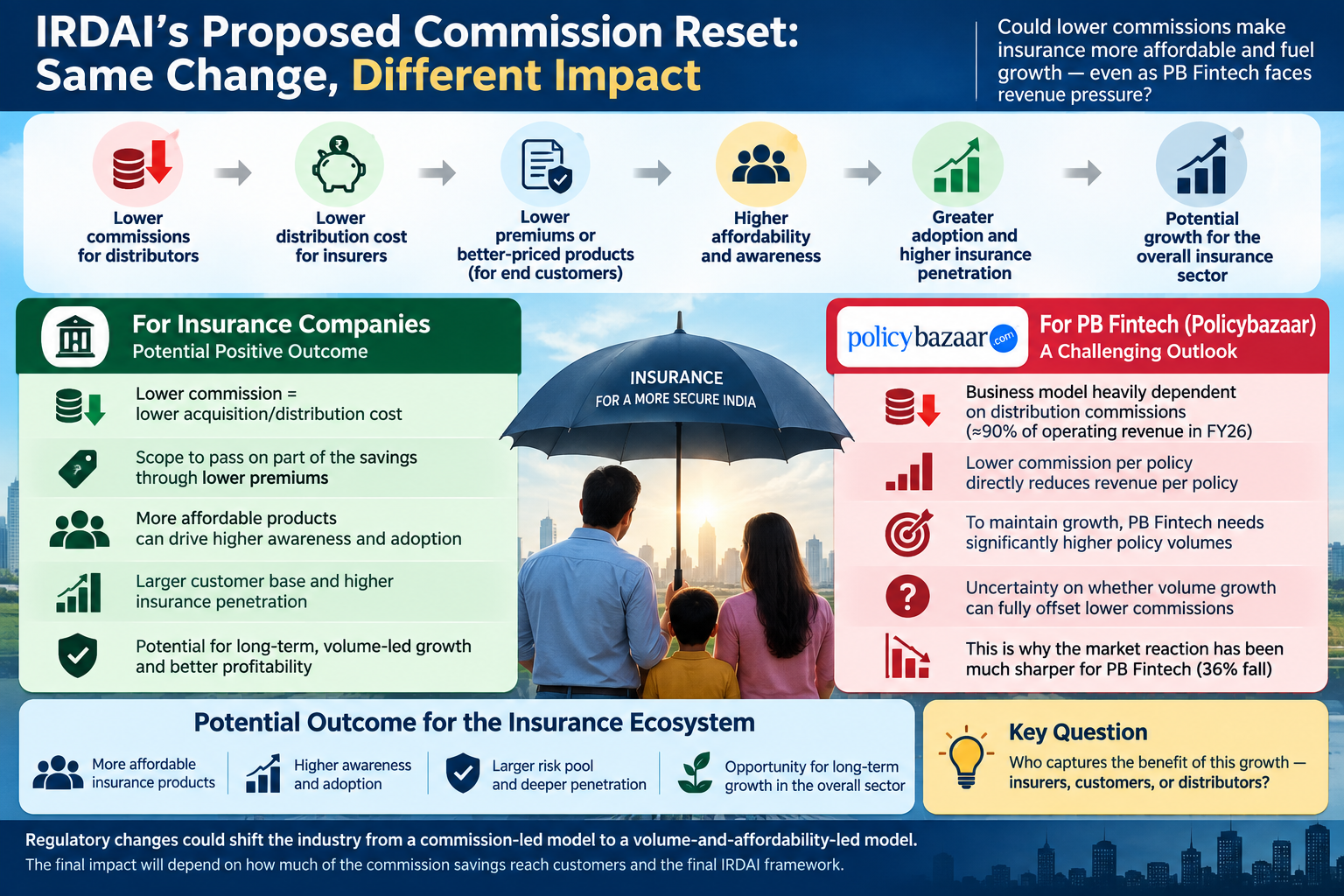
IRDAI’s proposed commission reset creates an interesting paradox for the insurance sector. If insurers pass a meaningful portion of the commission savings to customers through lower premiums, insurance could become more affordable. Lower premiums → higher affordability → greater adoption → larger insurance pool → potentially higher insurance penetration. That could be positive for the insurance industry in the long run. But for insurance distributors such as PB Fintech, the equation is different. PB Fintech’s business model is heavily dependent on insurance distribution commissions. In FY26, around 90% of its operating revenue came from insurance commission, according to reported company/industry data. Therefore: Lower commission × same volume = lower distributor revenue To maintain growth, PB Fintech would need: Lower commission per policy + significantly higher policy volumes = sustainable growth And this is where the real debate begins. The proposed framework could potentially shift the insurance industry from a commission-led distribution model toward a volume-and-affordability-led model. For insurers, that could mean lower acquisition costs and potentially greater volumes. For distributors, however, the challenge is whether volume growth can compensate for the compression in revenue per policy. This may explain why the market reaction has been much sharper for PB Fintech than for some insurers. The proposed rules are still under consultation, so the final economics remain uncertain. The interesting question isn’t simply “Will insurance grow?” It’s: “Who captures the benefit of that growth—insurers, customers, or distributors?” Aakash Bisht
- March 28, 2024
- Capitree Asset LLP
₹500 for Breathing? Ashneer Grover’s || Government announced UPI MDR 0.4%
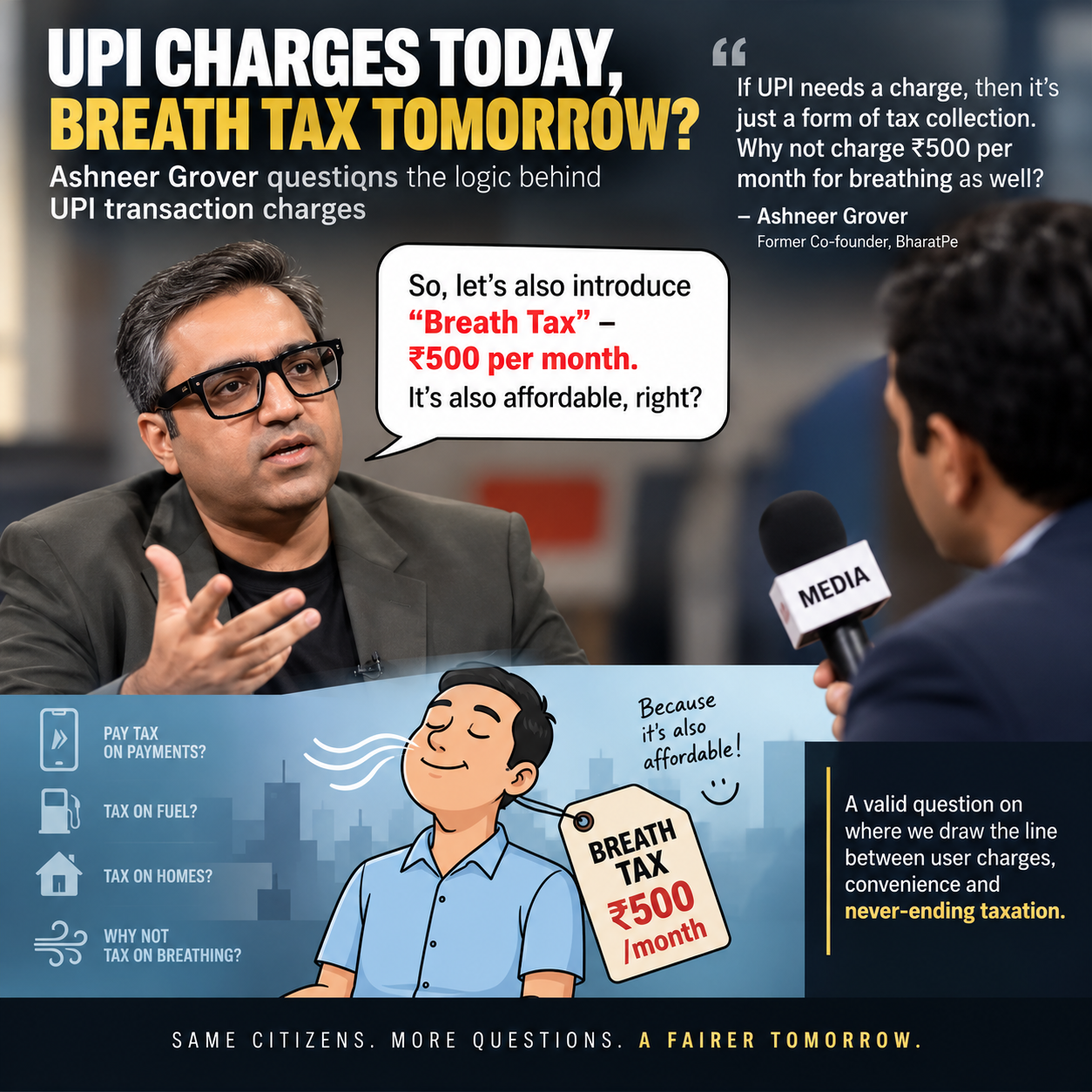
₹500 for Breathing? Ashneer Grover’s UPI Analogy Raises an Interesting Finance Question “Why not charge ₹500 a month for breathing? It’s affordable, right?” That was Ashneer Grover’s analogy while questioning the rationale behind the newly announced UPI Merchant Discount Rate (MDR). From 15 October 2026, a 0.4% MDR will apply to specified UPI merchant transactions above ₹2,000, with a ₹300 cap. The government says this is not a tax, will be borne within the merchant payment ecosystem, and that around 96% of P2M transactions will remain unaffected. But Grover’s analogy points towards a broader finance question: When an essential digital infrastructure becomes deeply embedded in everyday economic activity, where should the cost of maintaining that infrastructure sit? From a finance professional’s perspective, the debate isn’t simply about whether 0.4% is affordable. It is about: Cost → Incidence → Margins → Pricing → Consumer impact A merchant may technically bear the MDR. But if the cost affects merchant margins, competitive pricing or operating economics, the eventual economic incidence can become a larger question. At the same time, UPI infrastructure isn’t costless. Banks, payment platforms, cybersecurity, technology and transaction processing require continuous investment. The government argues that MDR is intended to support the long-term sustainability of this ecosystem. So perhaps the real question isn’t: “Can we afford the charge?” It is: “What is the economically justified cost of using a public digital payment infrastructure—and who should bear it?” That’s a much more interesting finance debate than simply calling UPI “free” or “paid.” Aakash Bisht, Strategic Consultant #UPI #MDR #Fintech #DigitalPayments #Finance #BusinessFinance #FinancialAnalysis #NPCI #Payments #India
- March 28, 2024
- Capitree Asset LLP
Revenue is growing. So why is cash still tight?
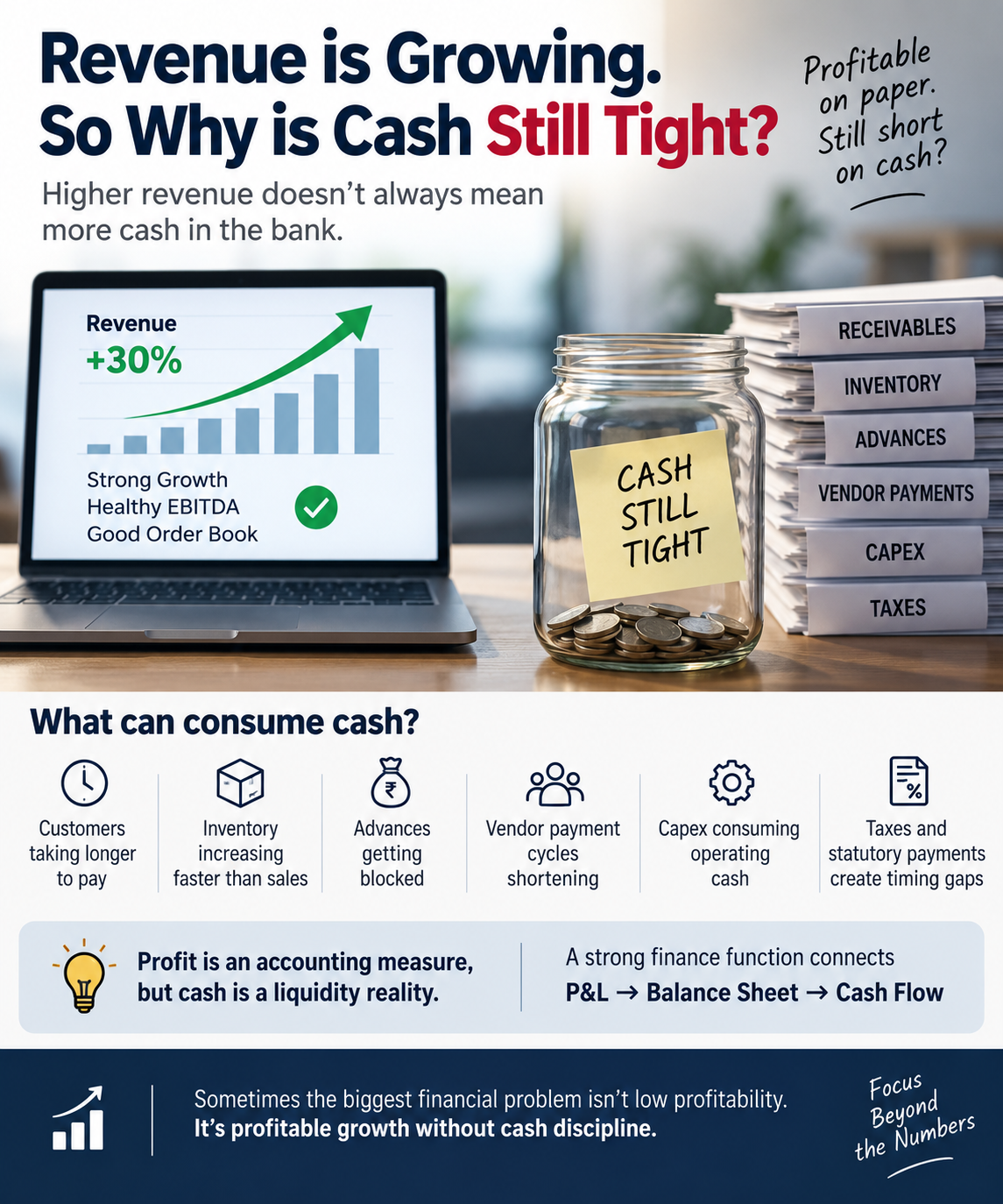
Revenue is growing, but Cash isn’t ! One of the most common mistakes in business is assuming: Higher Revenue = More Cash Not necessarily. A company can report: 📈 30% growth in revenue 📈 Healthy EBITDA 📈 Strong order book …and still struggle to pay its vendors or meet monthly obligations. Why? Because profit is an accounting measure, while cash is a liquidity reality. A few things can consume cash even when the P&L looks healthy: • Customers are taking longer to pay • Inventory is increasing faster than sales • Advances are getting blocked • Vendor payment cycles are shortening • Capex is consuming operating cash • Taxes and statutory payments create timing gaps This is where finance needs to go beyond: “How much did we earn?” and start asking: “Where is the cash stuck?” A strong finance function should connect: P&L → Balance Sheet → Cash Flow Because sometimes the biggest financial problem isn’t low profitability. It’s profitable growth without cash discipline. Aakash Bisht, Strategic Consultant #Finance #FPandA #BusinessFinance #CashFlow #WorkingCapital #FinancialManagement #FinanceProfessionals

- March 13, 2024
- Capitree Asset LLP
A Financial Inclusion Plan for the whole sector
Dicta sunt explicabo. Nemo ipsui enim ipsamo voluptatem quia voluptas sit aspernatur auton lorem ipsumo that Check our docs toots see if we’ve already answered question Lorem ipsum dolor sit, consectetur adipiscing elit. Cursus ornare non non massa elit rutrum. Erosie proin nibh neque interdum accumsan, neque vitae. Tortor etiam sed suspendisse faucibus ac volutpati mattis tortor nec. Orc velit a, posuere turpis amet. Lectus lacus lectusio habitasse amet quam libero, and lorem. Volutpat odio maecenas viverra consequat condimentum diam donectoi aliquet. Natoque quam id vitae leo risus. Eget neque proin in dolor cursus bibendum urna dictum. Dicta sunt explicabo. Nemo ipsui enim ipsamo voluptatem quia voluptas sit aspernatur auton lorem ipsumo that Check our docs toots see if we’ve already answered question Lorem ipsum dolor sit, consectetur adipiscing elit. Cursus ornare non non massa elit rutrum. Erosie proin nibh neque interdum accumsan Platea sed fames at egestas amet feugiat laoreet Duis et enim justo, in mauris posuere dolor magnis felis sapien sit egestas. Ut venenatis faucibus non sed faucibus mauris ultricies. Mauris donec ociis et magnis sapien etiam sapien sagittis congue tempor gravida done Amet minim mollit non deserunt ullamco est sit aliqua dolor do amet sint. “Lorem ipsum dolor sit amet, consectetur adipiscing elit amet purus tempor dui pharet consequat nibh elit urna interdum viera quam and arcu duis quis lectus donec nulla aliquam Ronald Richards Service taker Use Finance to get tax return Dicta sunt explicabo. Nemo ipsui enim ipsamo voluptatem quia voluptas sit aspernatur auton lorem ipsumo that Check our docs toots see if we’ve already answered question Lorem ipsum dolor sit, consectetur adipiscing elit. Cursus ornare non non massa elit rutrum. Erosie proin nibh neque interdum accumsan, neque vitae. Tortor etiam sed suspendisse faucibus ac volutpati mattis tortor nec. Orc velit a, posuere turpis amet. Lectus lacus lectusio habitasse amet quam libero, and lorem. Volutpat odio maecenas viverra consequat condimentum diam donectoi aliquet. Natoque quam id vitae leo risus. Eget neque proin in dolor cursus bibendum urna dictum. Dicta sunt explicabo. Nemo ipsui enim ipsamo voluptatem quia voluptas sit aspernatur auton lorem ipsumo that Check our docs toots see if we’ve already answered question Lorem ipsum dolor sit, consectetur adipiscing elit. Cursus ornare non non massa elit rutrum. Erosie proin nibh neque interdum accumsan Dicta sunt explicabo. Nemo ipsui enim ipsamo volupt quia voluptas sit aspernatur auton lorem ipsumo that Check our docs toots see if we’ve already answered question Lorem ipsum dolor sit, consectetur adipisci elit. Cursus ornare non non massa elit rutrum. Erosie proin nibh neque interdum accumsan, neque vitae. Tortor etiam suspendisse faucibus volutpati mattis tortor nec. Orc velit a, posuere turpis ametis. Lectus lacus lectusio habitasse amet quam liberon, and lorem. Volutpat odio maecenas viverra loremon consequat condimentum diam Generate AI Copy writing Favorite Tools Dicta sunt explicabo. Nemo ipsui enim ipsamo voluptatem quia voluptas sit aspernatur auton lorem ipsumo that Check our docs toots see if we’ve already answered question Lorem ipsum dolor sit, consectetur adipiscing elit. Cursus ornare non non massa elit rutrum. Erosie proin nibh neque interdum accumsan, neque vitae. Tortor etiam sed suspendisse faucibus ac volutpati mattis tortor nec.